Urban Heat Island (UHI) Analysis
Max Anjos
September 18, 2026
Source:vignettes/local_func_uhi.Rmd
local_func_uhi.RmdIntroduction
The lcz_uhi_intensity() function is designed to
calculate the Urban Heat Island (UHI) intensity based on air temperature
measurements and Local Climate Zones (LCZ). UHI intensity is defined as
the temperature difference between urban and rural areas, providing a
quantitative measure of how much warmer urban areas are compared to
their surrounding rural environments.
This guide demonstrates how to use the
lcz_uhi_intensity() function to calculate and analyze UHI
intensity using LCZ classes. The function supports two calculation
methods:
Method 1: LCZ-Based Method
Automatically identifies LCZ built types (LCZ 1-10) to represent urban temperature, while LCZ natural types (LCZ A-G / 11-17) represent rural temperature. This method is ideal when you have comprehensive LCZ classification across your study area.
Method 2: Manual Method
Allows users to manually select specific stations as references for urban and rural areas. This method is useful when you have pre-defined reference stations or when LCZ classification is incomplete.
library(LCZ4r)

# Get the LCZ map for your city
lcz_map <- lcz_get_map_euro(city = "Berlin")

# Load sample data from LCZ4r
data("lcz_data")
Understanding UHI Intensity:
- Positive UHI intensity (red): Urban areas are warmer than rural areas (typical urban heat island)
- Negative UHI intensity (blue): Urban areas are cooler than rural areas (urban cool island)
- Zero UHI intensity: No temperature difference between urban and rural areas
UHI intensity typically peaks during nighttime and can vary significantly by season and weather conditions.
UHI Time Series
This example calculates hourly UHI intensity aggregated by month for the year 2019, providing insights into seasonal patterns of urban heating.
# Calculate hourly UHI intensity by month for 2019
lcz_uhi_intensity(lcz_map,
                  data_frame = lcz_data,
                  var = "airT",
                  station_id = "station",
                  time.freq = "hour",
                  method = "LCZ",
                  year = 2019,
                  by = "month")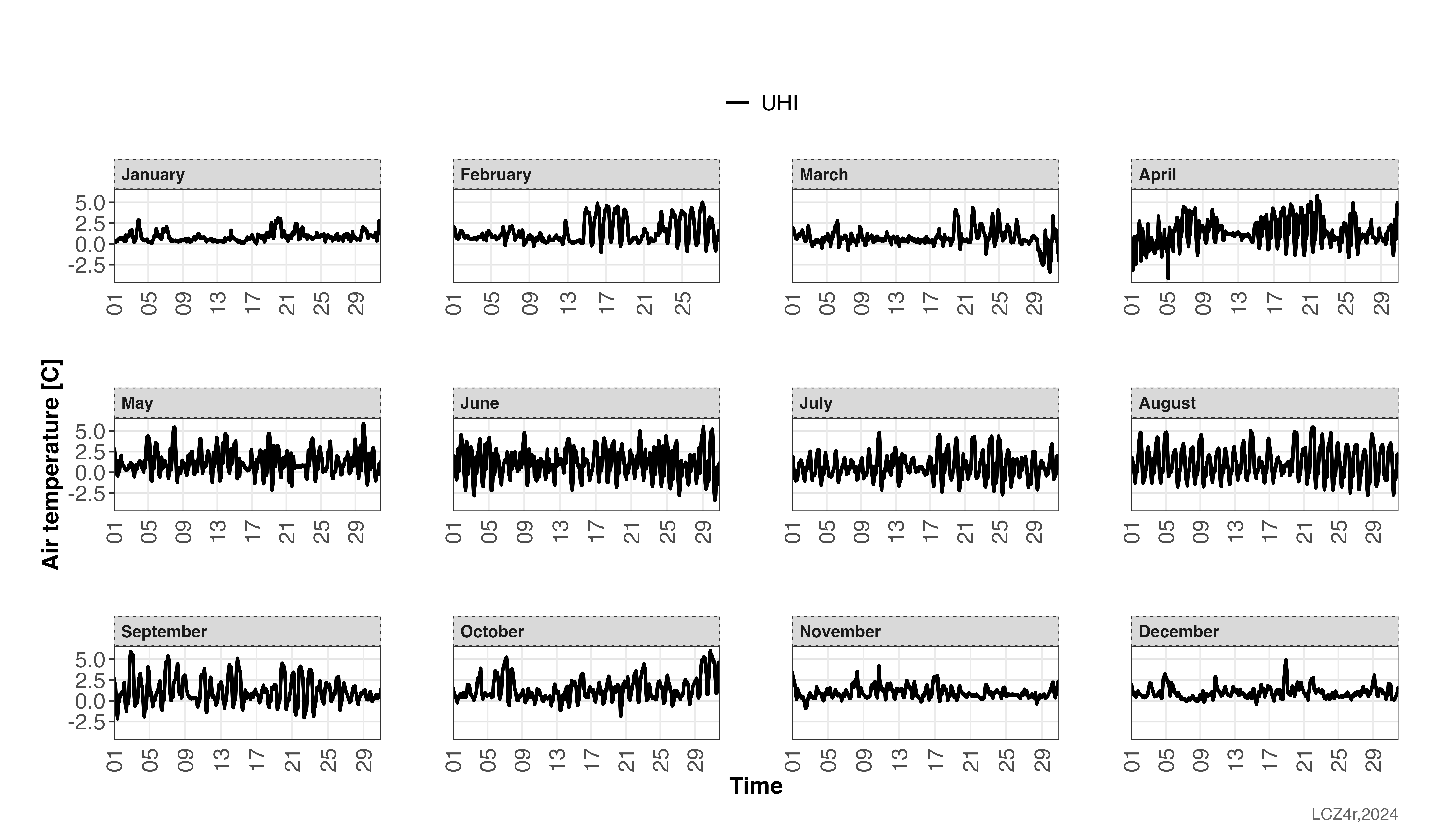
Monthly UHI intensity time series for Berlin in 2019. Positive values indicate urban areas are warmer than rural areas, with peak intensity typically observed during summer months.
UHI Seasonality
This analysis splits the data by season, providing a more detailed
view of how UHI intensity varies throughout the year. The
group = TRUE parameter also displays the urban and rural
temperature components separately.
# Calculate hourly UHI intensity by season for 2019, including urban and rural temperatures
lcz_uhi_intensity(lcz_map,
                  data_frame = lcz_data,
                  var = "airT",
                  station_id = "station",
                  time.freq = "hour",
                  method = "LCZ",
                  year = 2019,
                  by = "season",
                  group = TRUE)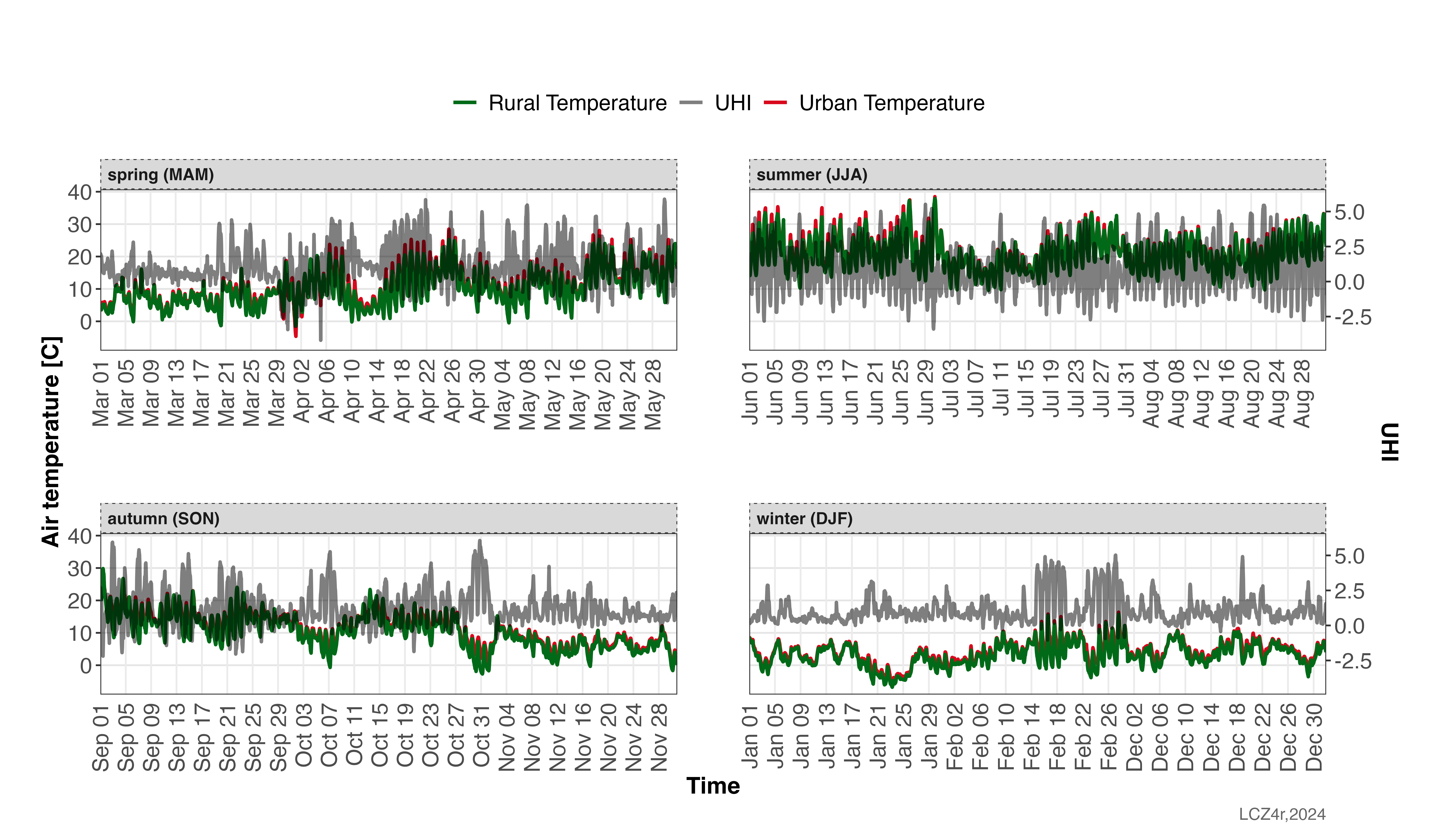
Seasonal UHI intensity patterns showing urban and rural temperature components. This visualization helps identify seasonal variations in UHI magnitude and the contributing temperature differences.
UHI Diurnal Cycle
Understanding the diurnal (day-night) cycle of UHI intensity is crucial for urban climate studies. This example calculates the diurnal pattern for a specific date.
# Calculate diurnal cycle of UHI intensity for February 6, 2019
lcz_uhi_intensity(lcz_map,
                  data_frame = lcz_data,
                  var = "airT",
                  station_id = "station",
                  time.freq = "hour",
                  method = "LCZ",
                  year = 2019, month = 2, day = 6,
                  by = "daylight",
                  group = TRUE)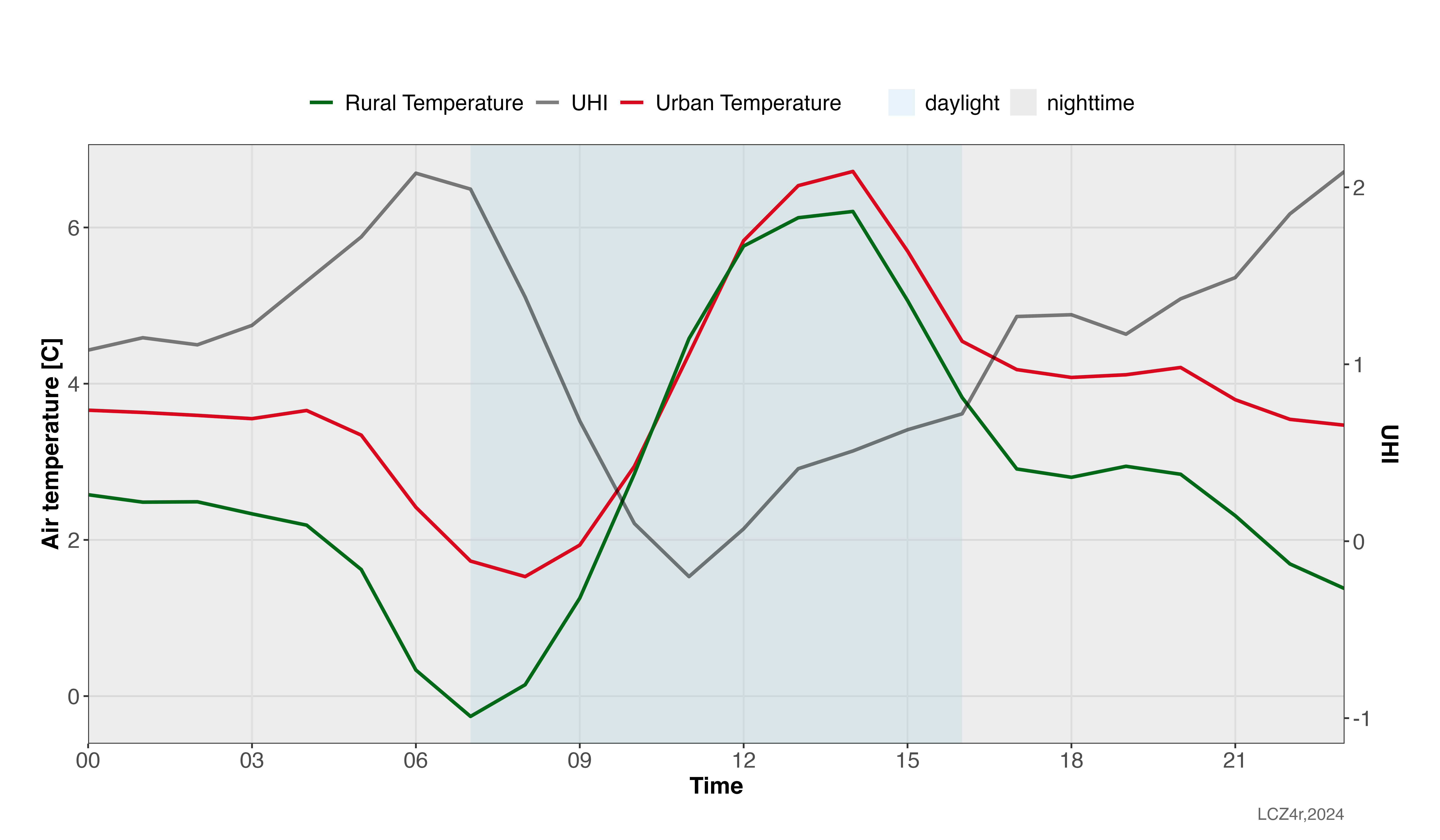
Diurnal cycle of UHI intensity on February 6, 2019, showing distinct patterns between daytime and nighttime periods. UHI intensity typically strengthens after sunset.
Manual Method: Custom Reference Selection
The manual method allows you to specify custom stations as urban and rural references. This is particularly useful when you have specific monitoring stations that serve as representative references for your study area.
# Calculate diurnal cycle of UHI intensity for February and July 2019 using manual method
lcz_uhi_intensity(lcz_map,
                  data_frame = lcz_data,
                  var = "airT",
                  station_id = "station",
                  time.freq = "hour",
                  year = 2019, month = c(2, 7), day = 6,
                  method = "manual",
                  Turban = "bamberger",      # Urban reference station
                  Trural = "airporttxl",     # Rural reference station
                  by = c("daylight", "month"),
                  group = TRUE)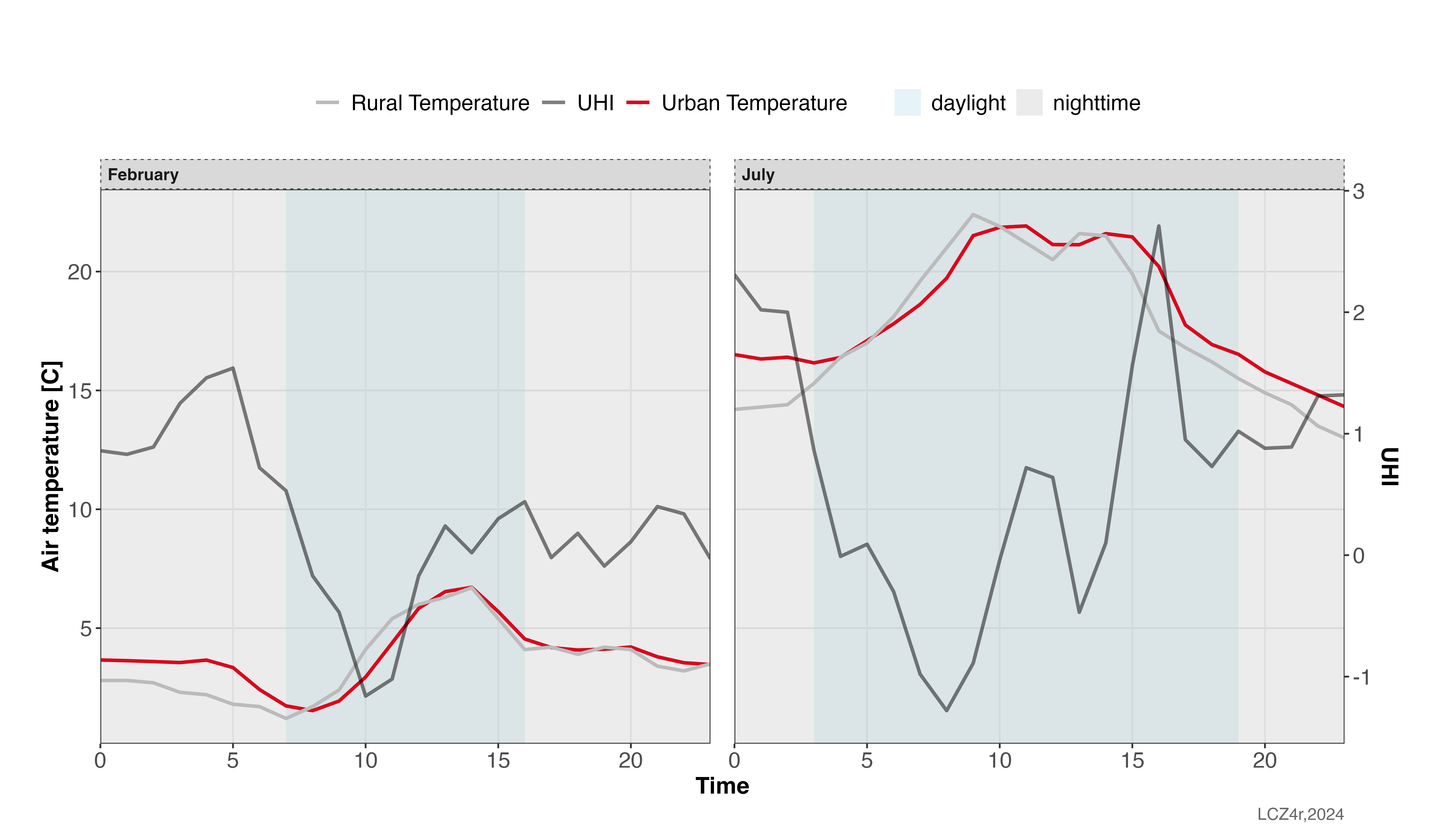
UHI intensity comparison between winter (February) and summer (July) 2019 using custom reference stations. This demonstrates the flexibility of the manual method for targeted analysis.
Advanced Analysis Options
Multiple Time Frequencies
You can analyze UHI intensity at different temporal aggregations:
# Daily UHI intensity for summer 2019
daily_uhi <- lcz_uhi_intensity(lcz_map,
                               data_frame = lcz_data,
                               var = "airT",
                               station_id = "station",
                               time.freq = "day",
                               method = "LCZ",
                               year = 2019, month = 6:8,
                               iplot = FALSE)

# Monthly UHI intensity for 2019
monthly_uhi <- lcz_uhi_intensity(lcz_map,
                                 data_frame = lcz_data,
                                 var = "airT",
                                 station_id = "station",
                                 time.freq = "month",
                                 method = "LCZ",
                                 year = 2019,
                                 iplot = FALSE)
Combining Multiple Splitting Options
You can combine multiple splitting criteria for more detailed analysis:
# UHI intensity by weekday and season
lcz_uhi_intensity(lcz_map,
                  data_frame = lcz_data,
                  var = "airT",
                  station_id = "station",
                  time.freq = "hour",
                  method = "LCZ",
                  year = 2019,
                  by = c("weekday", "season"),
                  group = TRUE)
Statistical Summary
You can return the data frame for further statistical analysis:
# Return UHI intensity data frame for statistical analysis
uhi_data <- lcz_uhi_intensity(lcz_map,
                              data_frame = lcz_data,
                              var = "airT",
                              station_id = "station",
                              time.freq = "hour",
                              method = "LCZ",
                              year = 2019,
                              iplot = FALSE)

# Calculate summary statistics
summary(uhi_data)

# Calculate seasonal means
aggregate(uhi_value ~ season, data = uhi_data, FUN = mean)
Save Plots
To save plots to your computer, set isave = TRUE and
specify the file type:
# Save UHI intensity plot to PC
lcz_uhi_intensity(lcz_map,
                  data_frame = lcz_data,
                  var = "airT",
                  station_id = "station",
                  time.freq = "hour",
                  method = "LCZ",
                  year = 2019,
                  by = "season",
                  group = TRUE,
                  isave = TRUE,
save_extension = "png")Tip: Saved plots are automatically organized in the
LCZ4r_output folder with descriptive filenames including
the analysis parameters and timestamp.
Practical Applications of UHI Analysis
Understanding UHI intensity patterns can inform various urban planning and climate adaptation strategies:
1. Heatwave Preparedness
Identify periods and areas with highest UHI intensity to target heatwave interventions and early warning systems.
2. Urban Planning
Use seasonal and diurnal patterns to guide urban design decisions, such as: - Placement of green infrastructure - Building height and density regulations - Cool material implementation strategies
3. Climate Change Adaptation
Establish baseline UHI patterns to monitor changes over time and evaluate the effectiveness of mitigation measures.
4. Public Health Planning
Identify vulnerable populations in areas with persistent high UHI intensity for targeted health interventions.
Important Considerations:
- UHI intensity calculations require adequate spatial coverage of monitoring stations across both urban and rural areas
- Weather conditions (wind speed, cloud cover) can significantly influence UHI intensity
- The LCZ method assumes that built LCZs represent urban conditions and natural LCZs represent rural conditions
- Consider using the manual method when LCZ classification is incomplete or when specific reference stations are preferred
Summary of Parameters
Here’s a quick reference for the main parameters used in
lcz_uhi_intensity():
| Parameter | Description | Options |
|---|---|---|
time.freq |
Temporal aggregation frequency | “hour”, “day”, “month”, “year” |
method |
Calculation method | “LCZ” (automatic), “manual” (custom) |
Turban |
Urban reference station (manual method) | Station ID for urban reference |
Trural |
Rural reference station (manual method) | Station ID for rural reference |
by |
Data splitting method | “month”, “season”, “daylight”, “weekday”, etc. |
group |
Display urban/rural components | TRUE/FALSE |
isave |
Save output to PC | TRUE/FALSE |
iplot |
Display plot | TRUE/FALSE |
Interpreting Results
When analyzing UHI intensity results, consider:
- Peak intensity times: Typically 3-5 hours after sunset
- Seasonal patterns: Often strongest in summer and winter (depending on climate)
- Weather influences: Clear, calm nights produce strongest UHI signals
- Urban morphology: Compact built areas usually show higher intensity than open areas
- Vegetation effects: Green spaces can significantly reduce local UHI intensity
Have feedback or suggestions?
Do you have an idea for improvement or did you spot a mistake? We’d love to hear from you! Click the button below to create a new issue (GitHub) and share your feedback or suggestions directly with us.
Open GitHub issue